Tuesday, April 25, 2017

Diving in to the end!

Dear Students,
Wow!  What an amazing semester!  Is the book challenge really coming to an end?  It's been such a joy peeking into the books you are reading on your book blogs!  
With Alice, I’ve been reading Lea Dives In, which is the book that accompanied her American Girl Doll, Lea, she got for her 8th birthday. I first heard ALL about Lea’s story from the saleswoman at the American Girl Doll Store (to me it was almost quite creepy how invested she was with the stories for each doll!). Anyway, Lea is setting off on a trip to Brazil to stay with her brother who is studying in the Rainforest.
We find that Lea’s late grandmother was quite the traveler and brave. Lea has been given her grandmother’s journal and the author weaves diary entries from her grandmother throughout the story’s narrative. Lea, however, has a fear. A deep fear of the ocean. I’m excited to read about how she overcomes this fear and how her bravery might set a positive example for my daughter.
I also like the idea of travel journals and think this would be a good extension for our upcoming trip to Florida. Alice could write about her adventures in the same way Lea is doing in this text. Also, little facts and information about Brazil are uncovered as we read. It’s nice to be able to learn a bit about a different culture through this text.
I’ve also downloaded an audio book from the Overdrive app.  I know I've mentioned this before, but you should really check out the Overdrive app.  You can connect your public library card to this app and check out ebooks and audio books to play through your computer, tablet, or smartphone! I love to check out audio books and play them in the car through my Aux input while driving back and forth to Kokomo.
I’m looking forward to listening to the rest of this novel!
Happy reading,
Dr. K.

Wednesday, April 12, 2017

What if you had all the answers??

I have been plugging my way through my next children’s book, All the Answers by Kate Messner. It’s a genius idea and the story’s plot is well crafted. Here is the book’s preview on her website:
What if your pencil had all the answers? Would you ace every test? Would you know what your teachers were thinking? When Ava Anderson finds a scratched up pencil she doodles like she would with any other pencil. But when she writes a question in the margin of her math quiz, she hears a clear answer in a voice no one else seems to hear.
With the help of her friend Sophie, Ava figures out that the pencil will answer factual questions only – those with definite right or wrong answers – but won’t predict the future. Ava and Sophie discover all kinds of uses for the pencil, and Ava’s confidence grows with each answer. But it’s getting shorter with every sharpening, and when the pencil reveals a scary truth about Ava’s family, she realizes that sometimes the bravest people are the ones who live without all the answers…
The books begs the question, “Is knowledge power?” or is “the less you know is sometimes better?” Immediately, I think about genetic testing as Alzheimer’s runs heavily in my family. I’ve contemplated if I would want to know if I have the gene for this debilitating disease for prevention purposes or would that knowledge destroy my outlook on life? I believe the latter to be true, so I opt to live blind and hopeful a cure will be discovered before I lose my mind (as if I haven’t already!)
Ava is an anxious child and how she uses the pencil is quite interesting. Although the pencil was first discovered by using it on a Math test, she implements a rule NOT to use it for tests (because that would be cheating). As the story goes, she gets greedy for answers, answers that may have been better left unknown. Her anxiety keeps her away from new and unknown situations, afraid to tackle challenges that seem scary. My oldest is going through this as well. Ava, like my daughter, questions why she has to feel this anxiety. Why does it affect her and not her peers? As I’m heading into the end of this book, I’m anxious to see how she faces her family’s challenge (not going to give that away to you!), and how this challenge might change her outlook on life. Will she surprise herself by taking the lead and being brave for the sake of her family?
This book begs a question for discussion:
“What if your pencil has all the answers?”
Until next week!
Dr. K.

Tuesday, March 28, 2017

El Deafo es Asi Asi


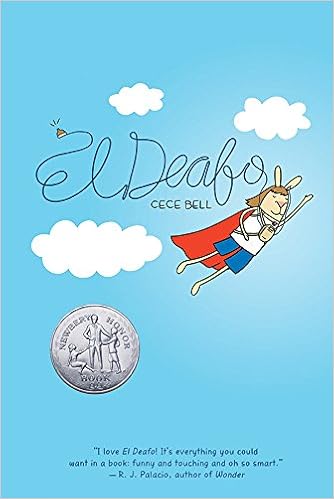
My daughter is REALLY into graphic novels - My theory is that they are a chapter book, but still have the feel of a picture book (I think all text intimidates her reading--although she is finally transitioning out of this stage).  This week, I searched on Overdrive (where you can link your library card for FREE e-texts!), adn thought I’d try out the graphic novel, El Deafo, by Cece Bell. There’s no doubt this is a memoir of the author’s life (first clue, the main character’s name is Cece, AND of course, the afterward shares this connection posted at the end of the book).
So, this novel tells the story of Cece, who was born of hearing and became deaf after battling meningitis at the age of four. At first, she is scared and clings to her mother as she begins to figure out her newly changed world.
In this story, we are taken through her childhood through 5th grade. She battles bullying, insecurities, and a boy crush along the way. Her “phonic ear” or rather large and bulky hearing aid with cords to her ears is bulky, and she is ashamed of how this makes her difference transparent to her peers (See this picture--Never knew this!)
Although I love the fact this book highlights differences and how other feel who are categorized as “different” from a handicap, I found the comic style quite dull at points. She goes through her friends sequentially and how she liked or didn’t like them. I found myself quite annoyed at times with how long these sections of the book dragged on. The author did use the analogy of her living in a bubble, which I found to be a great analogy for her life. And the protagonist, CeCe, fantasizes herself as a superhero when she discovers how she can hear the teacher (who has a connected microphone she wears around her neck) allows CeCe to hear wherever her teacher was in the building (even while using the restroom!—this part I’m sure students would find quite amusing!). At the end of the story, she does become a true superhero when her peers find this “superpower” quite fascinating, and she soaks in that attention!
Overall, I think it is an interesting medium to tell her story (graphic novel) and elementary students respond well to graphic novels. My niece too has a hearing aid and her teacher as well wears and amplifying microphone. I do think I will recommend this book to her, and possible see if my daughter might find it a better read than me.  However, it did win the Newbery Honor Award.  
Until next week!
Dr. K.

Tuesday, February 28, 2017

Rules & Order: Do you Follow?

Dear Students,
This week I finished listening to The Maze Runner, and still continuing to read Flora & Ulysses. I did like the Maze Runner, but not enough to want to finish the trilogy.  I can see how this type of novel would be a good fit for many upper elementary readers looking for a challenge. 
I was particularly interested in looking at The Maze Runner in regards to particular themes.  I did some research and found this list @ http://www.shmoop.com/the-maze-runner/themes.html which includes the following themes: 
  • Manipulation
  • Memory
  • Rules & Order
  • Fear
  • Identity
  • Sacrifice
  • Justice & Judgment
  • Freedom & Confinement
Looking at this list from a teacher’s perspective, this novel could raise some interesting book club discussions.  I’ll discuss one theme within this list, Rules & Order.
I’m very much a rule follower, and I can honestly say I follow rules primarily out of fear—fear I will get caught, fear I will be judged, fear I will set a bad example.  In this novel, I think about the boy’s and their constant adherence to the rules.  The rules kept the glade functioning, but it was Thomas who first broke the major rule (never enter the Maze at night).  My question I ponder is, Was it the system of rules that helped the children find their way out of the maze or was it Thomas’s rule breaking tendencies that allowed the escape?  At first thought, I would say Thomas.  He was the trigger and the one who first questioned the rules.  However, without the rules of the runners to map the day’s route, the code would not have been discovered.  This leads to a larger essential question one could use with students, Are rules meant to be broken? – That could lead to a heated debate and tap into students’ higher order thinking skills for sure!  Of course my mind was constantly making connections to other texts such as my recent novel, Divergent and a classic favorite The Giver.
Overall, I would recommend this book for you to read.  It’s suspenseful and taps into one’s curiosity.  I’m moving out of Science Fiction books this week and reading a realistic fiction book, which is actually my favorite genre. 
Until next week,
Dr. K.

Tuesday, February 14, 2017

Diverged . . .

Dear Students,
Well, I started the week off strong with reading Divergent, but have diverged (ha!) some since midweek due to a few work deadlines.  I am rereading Wonder with my 9-year-old daughter, and I have managed to tackle two Junie B. Jones books with my 6-year-old daughter, although Junie’s terrible grammar always drives me crazy . . .am I the only one? 
OK-back to Divergent.  The plot is intensifying and her Divergent nature is becoming Tris’sa “achilles heel” so to speak.  She has taken to the leader, Four, and now knows his deepest fears, along with his history.  This week we have examined loyalty, friendship, and trust, all greatly impacted by the competitive nature of the faction. 
 I was glad to see Tris’s mom attend the family visit.  I figured, based on her dad’s reaction at the choosing ceremony, he wouldn’t be able to face his Dauntless daughter, but the mother has become quite an intriguing character.  She has a past Tris is starting to unravel. 
Tris is transforming.  She is becoming stronger and more aggressive.  I personally can’t imagine turning to violence to solve life’s problems, but violence has become a necessity for her survival.  And then there is the chasm, which defined is a “deep cleft in the earth's surface; gorge.” The chasm is filled with sharp rocks, running waters, and embodies fear.   It seems the chasm is representative of a fine line between bravery and stupidity.  It is at the chasm where we see threats, murder, suicide, friendship, and love.  I anticipate the chasm continuing to be a central focal point of this story. 
Until next week!

Tuesday, February 7, 2017

Divergent

Although it’s been a challenge this week with the flu bug circulating my household, I’ve secured at least 15 minute each day for reading—I’ve carried the novel, Divergent, in my purse "mom bag" and found “stolen time” at the doctor’s office, in the car, and turning off my computer at night before bed to read.  It’s been refreshing to take my mind off life, especially work, to dive into Beatrice’s dystopian Chicago society.  
Her society is divided into five factions.  There is the Candor (honest souls), Abnegation (her former selfless self), Amity (peacemakers), Erudite (academics), and the Dauntless (her new self, the brave).  On her 16th birthday, she, and her classmates, must either decide to remain in their current faction, or devote her life to a new faction.  Beatrice, or Tris as she renames herself, in a last minute call, decides to test the waters of the Dauntless by letting her blood drop into new waters. 
Talk about an identity crisis!  I see my current self, my past, and my future within each faction.  The life I currently live (Erudite), my obsession with rule following (Candor), and the life I live only through others (Dauntless).  I see myself in Beatrice as she comes of age in this novel--moving away from home to test new waters.   Really, it’s the life of a typical teen isn’t it?   A constant flurry of emotions and life-changing decisions.  
            Tris realizes during the initiation that not all members will make the cut—but I know she will thrive.  She is already thriving in her new environment and showing confidence and strength, which are character traits I’m sure will continue to develop throughout the novel.  Her future, which seems uncertain at this point, will unfold during this novel, and I’m glad I’ve jumped on the train along with Tris. 
This book is well written, and the escape to my teenage years is a much-needed break! 
Till next week,
Dr. Kingsley

Thursday, November 17, 2016

The World According to Humphry

I recently read the book The World According to Humphrey which has a reading level of 4.2 (4th grade, 2nd month) and an interest level for grades 2-5. I ordered this book from the latest Scholastic Book Catalog.  I noticed my daughter has an interest in this series and her teacher was reading this book aloud to her students, so I thought I would read it myself as well!
So, Humphry is a class hamster in room 26. He loved his time spent with his long-term substitute teacher, Mrs. Mac, but since she’s left, he is heartbroken. When the classroom teacher, Mrs. Brisbane, returns, she does not want Humphrey, does not take him home each night like Mrs. Mac, leaving Humphrey alone and sad.
Humphrey ends up taking turns spending the weekend with first the principal (he wreaks havoc in his home!) and then various classmates. As he spends his time with classmates, we uncover new information about each child’s life (and eventually Mrs. Brisbane's life) that impacts his/her time at school.
What I loved about this book is how Humphrey is able to help each person solve problems. My favorite example of this from the story is the girl who doesn’t participate in class. Mrs. Brisbane pushes and pushes her to participate, even threatening to send a letter home to her parents. From his stay with her, Humphrey realized that English is not spoken in her home and her family has a minimal grasp on the English language. Because the child insists that everyone must speak English around Humphrey for that weekend, the mother makes the decision to enroll in English courses to help her learn the language.
This, to me, stresses the importance of cultural awareness and understanding cultural norms. Not all students see the world from a white, middle-class, and female perspective (i.e. the viewpoint of most elementary teachers).  Teachers must be considerate and understanding of this.
From a teacher’s viewpoint, this novel teaches children that each individual, each family, has its own story. Students could then write, create, draw, etc. THEIR story to share with the class---supporting cultural identities.
Looking forward to re-reading this book with my daughter. I’m also excited to share that I have a copy of Echo by Pam Munoz Ryan which was recommended to me by my friend and 5th-grade teacher.   Can’t wait to get started on that book today! 
Till next week,
Dr. Kingsley